

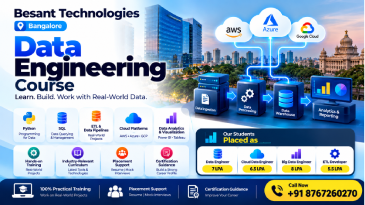
We Offer 100% Placement Assistance (Any Degree / Diploma Candidates / Year GAP / Non-IT / Any Passed Outs). Placement Records
Hire Talent (HR):+91-9707 240 250
If you want to learn how to turn data into information, you can join the Data Engineering Course in Bangalore. Besant Technologies, the No.1 Data Engineering Training Institute in Bangalore, teaches students, freshers, graduates, and working professionals about Python, SQL, cloud data engineering, Azure, Databricks, Apache Spark, and Microsoft Fabric through hands‑on sessions and real projects. Start by creating data pipelines, then move on to studying Microsoft Fabric and preparing for the DP‑700 certification. This course helps people gain the skills that're important for jobs in data engineering.
Data Engineering Course in Bangalore

Have Queries? Ask our Experts

+91-8767 260 270 Available 24x7 for your queries

About the Data Engineering Course in Bangalore

The Data Engineering Course in Bangalore at Besant Technologies is for people who want to see how data is handled in business. The Data Engineering Course covers programming, databases, cloud platforms, and data processing tools that data engineering teams use.

During the training, you will learn how to build ETL pipelines, move data between systems, clean data sets, and prepare data for analysis. Practical sessions let you see the ideas in action, with examples instead of just theory.

Why Choose the Best Data Engineering Course in Bangalore?

Choosing the course helps create a foundation before beginning a career in data engineering. The training includes technologies. Allows course participants to practice what they learn.

  • Training in Python and SQL basics builds skills.
  • An introduction to Azure data engineering services gives a look.
  • Practical learning with data integration and processing tools offers experience.
  • Exposure to Databricks, Apache Spark, and Microsoft Fabric increases knowledge.
  • Hands-on exercises and project-based learning strengthen understanding.

Training Option: The Data Engineering course in Bangalore is available in Online Live Instructor-Led Classes and Classroom Training Classes in our Bangalore Branches – BTM Layout, Marathahalli, HSR Layout, Electronic City, Indira Nagar, and Jayanagar, with Placements and Certifications.

Answer 3 Simple Questions

Get upto 30%* Discount in all courses. Limited Offer. T&c Apply.

Register now

Syllabus of Data Engineering Course in Bangalore

Programming Foundations & Data Modeling

Module 1: Python for Data Engineering

  • Python fundamentals, setup & environment, variables, data types, functions, modular code, loops, conditions and logic building.
  • Data Structures — Lists, tuples, sets, dictionaries and iteration techniques.
  • Pandas & NumPy — Series & DataFrames, data reading/writing, cleaning, filtering, sorting, aggregation and numerical operations.
  • Scripting & Automation — Running scripts, best practices and building reusable components.

Module 2: Data Handling with Python

  • Working with CSV, Excel and JSON, handling missing data and type conversions.
  • Data Cleaning & Transformation — Filtering, grouping, merging, joining and reshaping data.
  • Data Analysis Essentials — EDA, summary statistics, Matplotlib and Seaborn visualization.

Module 3: SQL Fundamentals

  • SELECT, WHERE, JOINs, filtering and sorting.
  • Query Writing & Optimization — Subqueries, indexing and execution plans.
  • Database Design Fundamentals — Normalization, keys and relationships.
  • Hands-on Practice — Real-world query-writing drills and exercises.

Cloud & Security

Module 4: Cloud & Microsoft Azure Foundations

  • Cloud computing basics, public/private/hybrid cloud models and real-world use cases.
  • Azure Fundamentals — Navigating Azure Portal and understanding key Azure services.
  • Cloud Service Models — IaaS, PaaS and SaaS with real-world examples.
  • Azure Environment Setup — Creating an account, first resource group and hands-on resource launch.

Module 5: Secure Identity & Access Management in Azure

  • Identity & access management, authentication vs authorization.
  • Microsoft Entra ID — Tenants, users, groups, roles and Role-Based Access Control (RBAC).
  • SPN & Managed Identity — Service principals and when to use each identity approach.
  • Security Best Practices — Secure access to storage, databases and Azure services.

Storage & Integration

Module 6: Azure Storage & Data Lake Fundamentals

  • Storage account basics and architecture for modern data platforms.
  • Blob Storage Essentials — Containers, folder structures, block blobs, append blobs and page blobs.
  • Advanced Storage Concepts — Metadata storage, audit logs and configuration management.
  • Queue Storage & Workflows — Table storage and queue storage for data engineering workflows.

Module 7: Azure Data Lake Storage Gen2

  • ADLS Gen2 architecture and hierarchical namespace.
  • Working with Data Lake — File systems, directories, files and configuration.
  • Data Ingestion & Management — Ingesting and accessing data in ADLS Gen2.
  • Data Lake Best Practices — Design concepts, performance optimization and cost optimization.

Module 8: REST APIs & Data Integration Fundamentals

  • REST APIs in data engineering and REST vs SOAP.
  • API Integration Concepts — Real-world data integration scenarios.
  • Working with APIs — Testing tools and CRUD operations.
  • API Data Handling — Data extraction and error management.

Module 9: Azure Data Factory

  • ADF architecture and pipeline execution flow.
  • Pipelines, Datasets & Integration Runtime — Linked services and dataset types.
  • Data Integration & Orchestration — Connecting Storage, SQL and REST services, scheduling and triggers.
  • Monitoring & Best Practices — Debugging, optimization and production-ready pipelines.

Processing (Azure Data Engineering)

Module 10: PySpark Foundations

  • Introduction to Databricks & Spark, SparkSession, execution flow, transformations vs actions and lazy evaluation.
  • Core Concepts & Data Structures — RDDs, DataFrames and Spark SQL.
  • Data Ingestion in PySpark — CSV, JSON and Parquet with schema inference.
  • Data Output in PySpark — DataFrame APIs, save modes and partitioning.

Module 11: Data Processing with PySpark

  • Joins, aggregations, data cleaning and type conversions.
  • Advanced Analytics with Spark SQL — Window functions and complex queries.
  • Performance Optimization — Partitioning, shuffle, caching and persistence.
  • Monitoring & Tuning — Spark UI, stages, tasks, executors and tuning best practices.

Module 12: Databricks Platform, Delta Lake & Governance

  • Databricks architecture, workspace, notebooks and clusters.
  • Data Connectivity & Storage — Connecting to ADLS Gen2, mounting and secure access.
  • Delta Lake Essentials — Delta architecture, Delta tables and ACID transactions.
  • Governance & Unity Catalog — Permissions, access control and data governance.

Module 13: Databricks Lakehouse Architecture & Pipelines

  • Lakehouse and Medallion architecture with Bronze, Silver and Gold layers.
  • Building Data Pipelines — Batch and real-time streaming pipelines.
  • Advanced Pipeline Concepts — Incremental processing and Change Data Capture (CDC).
  • Use Cases & Best Practices — Cost optimization and scalable pipeline design.

Microsoft Fabric

Module 14: Introduction to Microsoft Fabric

  • What Microsoft Fabric is and how it differs from Azure Data Engineering.
  • Microsoft Fabric Components — Unified platform for Data Engineering, Data Science and analytics.
  • Real-time Analytics in Fabric — Benefits for modern data engineering.
  • Microsoft Fabric Eventhouse — Real-time data ingestion and processing.

Module 15: Data Integration & Orchestration with Fabric

  • Dataflows Gen2 and data integration.
  • Pipelines for Data Engineering — Pipeline concepts and templates.
  • Run & Monitor Pipelines — Pipeline execution and performance tracking.
  • Real-time Data Processing — Ingest, transform, store, query and visualize data.

Module 16: Lakehouse, Delta Tables & Warehousing in Fabric

  • Lakehouse and Medallion architecture using Bronze, Silver and Gold layers.
  • Delta Tables in Fabric — Creating and handling Delta tables using Spark and structured streaming.
  • Data Warehousing in Fabric — Fact tables, dimensions and loading data using T-SQL.
  • Dataflows & Data Management — Loading, transforming, managing and protecting data.

Module 17: CI/CD, Deployment & Governance in Fabric

  • Data loading and pipeline strategies for Fabric Warehouse.
  • CI/CD in Microsoft Fabric — Git version control and deployment pipelines.
  • Automation with APIs & KQL — Automating CI/CD tasks and using KQL.
  • Advanced SQL & Analytics — Materialized views and stored functions.

Snowflake

Module 18: Snowflake Fundamentals & Architecture

  • Snowflake basics, use cases and why Snowflake is used for modern data platforms.
  • Setup & Environment — Creating a Snowflake account and navigating the Web UI.
  • Architecture & Storage Layers — Cloud services, compute and storage layers with micro-partitioning.
  • Data Types & Tables — VARIANT data type and permanent, temporary and transient tables.

Module 19: Data Loading & Transformation in Snowflake

  • Time Travel, Fail-safe and Zero Copy Cloning.
  • Stages & COPY Command — File formats and COPY command usage.
  • Streams, Tasks & Automation — SQL-based ETL and scheduling tasks.
  • Real-time ETL & Integrations — Data Lake integration and BI tool connections.

Module 20: Performance Optimization & Warehousing

  • Virtual warehouse sizing, auto-suspend and auto-resume.
  • Performance Tuning — Clustering keys and query profiling.
  • Caching & Optimization — Compute resource management.
  • Schema Design & Best Practices — Star vs snowflake schema and data modeling.

Module 21: Security, Governance & Data Sharing

  • Authentication, RBAC and sensitive data access.
  • Security & Monitoring — Encryption at rest/in transit and auditing.
  • Data Sharing & Masking — Secure data sharing features.
  • Governance Best Practices — Compliance and operational best practices.

Orchestration & Streaming

Module 22: Apache Airflow

  • Airflow fundamentals and components overview.
  • Installation & Setup — Installing Airflow and working with the Web UI.
  • DAGs, Operators & Tasks — Building workflows and managing dependencies.
  • Scheduling & Jobs — Creating, triggering and monitoring jobs.

Module 23: Apache Kafka

  • Kafka fundamentals, its need in data engineering and core concepts.
  • Kafka Architecture — Kafka use cases and cluster components.
  • Kafka Cluster Management — Brokers, topics, partitions, replication, producers and consumers.
  • Reliability & Best Practices — High availability and fault-tolerant Kafka architectures.

Capstone Project

  • Industry-Grade Capstone Project — Apply the concepts learned throughout the curriculum to build an end-to-end data engineering solution.
  • End-to-End Data Engineering — Work with data ingestion, storage, processing, transformation and analytics components.
  • Cloud Data Engineering — Implement a production-oriented solution using relevant Azure and modern data engineering technologies.
  • Portfolio Development — Build a project that demonstrates practical, industry-ready Data Engineer skills.
  • Real-World Scenario — Solve a business-focused data engineering problem using appropriate architecture and engineering practices.

Power BI & Business Intelligence

Module 26: Power BI & Business Intelligence

  • Connecting Power BI to Azure, Snowflake and Databricks data sources.
  • Data Modeling & DAX Basics — Relationships, calculated columns and measures.
  • Building Dashboards & Reports — Visuals, interactivity and drill-throughs.
  • Row-Level Security & Publishing — Securing, publishing and sharing Power BI reports.

DevOps

Module 28: DevOps

  • CI/CD concepts and automation using build and release pipelines.
  • Docker & Kubernetes — Containerization fundamentals and introduction to orchestration.
  • Infrastructure as Code — Automated environment provisioning and infrastructure management.
  • Real-world DevOps Projects — Applied hands-on practice with DevOps tools and workflows.

Try it out, on us

Take the first step in your learning journey. Get hands-on experience and be a master. Buy 3 course @24,999/-

Learn more

Upcoming Batch Schedule for Data Engineering Course in Bangalore

Besant Technologies provides flexible timings to all our students. Here are the Data Engineering Training Classes in Chennai Schedule in our branches. If this schedule doesn’t match please let us know. We will try to arrange appropriate timings based on your flexible timings.

  • 26-10-2026 Mon (Mon - Fri)Weekdays Batch 08:00 AM (IST)(Class 1Hr - 1:30Hrs) / Per Session Get Fees
  • 22-10-2026 Thu (Mon - Fri)Weekdays Batch 08:00 AM (IST)(Class 1Hr - 1:30Hrs) / Per Session Get Fees
  • 24-10-2026 Sat (Sat - Sun)Weekend Batch 11:00 AM (IST) (Class 3Hrs) / Per Session Get Fees
Data Engineering Course in Bangalore

Can’t find a batch you were looking for?

Corporate E-Learning & Training

Educate employee's in form of learning programs means in turn the success of your business/organization.

Tune up

Trainer Profile for Data Engineering Training in Bangalore

Learn from trainers who guide you step by step through data engineering concepts. They use examples and hands-on project-based exercises to make things clear. The training is built to help students understand the tools, remove any confusion, and put what they learn into real-world situations.

If you are a fresher or a working professional the guidance from our trainers can help you build a technical foundation. They support you in preparing for data engineering interviews. Ensure you gain confidence in your skills.

Find your next job with Besant

400+ Students getting placed every month from startup to top level MNC's with decent package after doing course.

Placement record Get your job

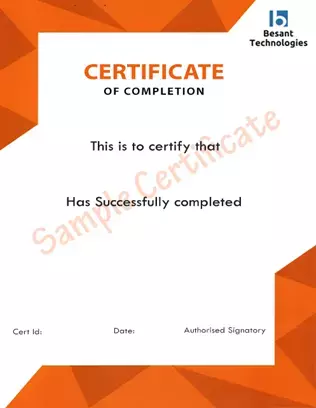
Data Engineering Course Certificate

Besant Technologies Certification is Accredited by all major Global Companies around the world. We provide after completion of the theoretical and practical sessions to fresher’s as well as corporate trainees.

Our certification at Besant Technologies is accredited worldwide. It increases the value of your resume and you can attain leading job posts with the help of this certification in leading MNC’s of the world. The certification is only provided after successful completion of our training and practical based projects.
Data Engineering Course in Bangalore

Microsoft Certified: Fabric Data Engineer Associate (DP-700) is a Microsoft certification for professionals who work with Microsoft Fabric data engineering solutions.

Microsoft Certified: Fabric Data Engineer Associate (DP-700) focuses on implementing and managing data engineering solutions, such as data ingestion, transformation, analytics solutions and optimisation, in Microsoft Fabric. Learners can use the course to build knowledge and prepare for further Microsoft Certified: Fabric Data Engineer Associate (DP-700) study.

Group Discount

Join in a group of three or more on same course we will be delighted to offer you a group discount.

Get Discount

Key Features of Data Engineering Training in Bangalore

  • Practical-oriented training.
  • Python and SQL fundamentals.
  • Azure data engineering concepts.
  • Data pipelines and ETL processes.
  • Databricks and Apache Spark introduction.
  • Microsoft Fabric learning.
  • Hands-on exercises and projects.
  • Flexible learning options, subject to batch availability.
  • Interview preparation and placement assistance.

Ready to jump-start your career

Join the course, Get your resume modified from experts. Our students are being hired at the leading companies.

Let's go

Training Courses Reviews

Balancing work and learning can be challenging, but structured sessions and practical exercises made the topics easier to follow. My trainer, Mr. Kalyan sir, helped me work through difficult concepts and strengthen my understanding of data engineering tools.

R

Ragavan

The project work was a valuable part of the course. Practising data workflows and working with SQL and Python helped me improve my technical understanding. The training also gave me a clearer idea of the skills expected in data engineering roles.

S

Sneha

Good institute to learn data engineering. My trainer, Ashwini ma’am, was friendly and helped us whenever we had doubts. The practical sessions were useful, especially for understanding data pipelines and SQL queries. I learned a lot during the course.

A

Anitha

Student's Testimonials

Student's Testimonials

Student's Testimonials

Placed Students

Frequently Asked Questions


Do you offer discounts on the Azure Data Engineer course?

Yes, we offer seasonal discounts and special offers on our courses. Call 📞 +91-8767260270 to learn about the latest offers available for the Data Engineering Course in Bangalore.

Why should I choose your institute for Azure Data Engineer training in Bangalore?

Our training combines updated course content with practical exercises and real-time projects. Experienced trainers guide learners through essential data engineering concepts, hands-on labs, resume preparation, and interview practice to help them prepare for data engineering roles.

Is placement assistance available after completing the Azure Data Engineer course?

Yes, placement assistance is provided to help learners prepare for job opportunities. This includes mock interviews, SQL and Python revision, real-world scenario practice, and job referrals through hiring partners.

Who teaches the Azure Data Engineering course?

The course is taught by experienced cloud and data engineering professionals. Their industry knowledge helps learners understand data engineering concepts through practical examples and real-world project scenarios.

What if I miss a training session?

If you miss a class, you can check with the training team about attending a session with another batch or rescheduling it. Session recordings may also be available for revision.

What training options are available for the Azure Data Engineer course in Bangalore?

We offer different training formats to suit learners’ schedules and requirements:

  • Classroom Training
  • One-to-One Training
  • Fast-Track Training
  • Live Online Training
  • Corporate Training

Learners can choose the mode that best fits their learning needs.

Which certification can I pursue after completing the Azure Data Engineer course?

The course helps learners build skills relevant to Microsoft data engineering certifications. You can explore the Microsoft Certified: Fabric Data Engineer Associate (DP-700) certification and the Azure Data Fundamentals (DP-900) certification, depending on your experience and learning goals. An institute course completion certificate may also be provided.

Do you offer group discounts or corporate training?

Yes, group training and corporate programs can be arranged with pricing tailored to the organisation’s requirements. Contact our team by phone or through the Quick Enquiry form to discuss your needs and get a quote.

What payment methods are accepted for the Azure Data Engineer course?

You can check the available payment options with our admissions team. Accepted methods may include:

  • Cash
  • Debit and Credit Cards
  • UPI and Digital Wallets
  • Net Banking

What is the average salary of a Data Engineer in Bangalore?

Data Engineer salaries in Bangalore vary based on experience, technical skills, certifications, and project exposure. Professionals with skills in SQL, Python, cloud platforms, and data processing tools may find opportunities across IT companies, startups, and product-based organisations. Salary packages differ by role and employer.

Which institute is a good choice for learning Azure Data Engineering in Bangalore?

Besant Technologies offers Data Engineering training in Bangalore with practical learning, project guidance, and placement assistance. Learners interested in Microsoft data engineering technologies can also explore the Microsoft Certified: Fabric Data Engineer Associate (DP-700) certification to build skills in modern data engineering with Microsoft Fabric.

Which certification is suitable for Data Engineers?

  • Microsoft Certified: Fabric Data Engineer Associate (DP-700): Relevant for professionals who want to develop and demonstrate data engineering skills using Microsoft Fabric.
  • Microsoft Azure Data Fundamentals (DP-900): Suitable for learners who want to understand foundational cloud data concepts before progressing to more advanced data engineering topics.

The right certification depends on your current knowledge, career goals, and the technologies you plan to work with.


Stay in the loop

Enroll for Classroom, Online, Corporate training.

Besant Technologies Data Engineering Course in Bangalore View 9 Locations Nearby

BTM Layout

No 2, Ground floor, 29th Main Road,
Kuvempu Nagar, BTM Layout 2nd Stage,
Bengaluru, Karnataka-560 076

Landmark: Next to OI Play School
View Location

Marathahalli

No. 43/2, 2nd Floor, VMR Arcade, Silver Springs Layout,
Munnekollal Varthur Main Road, Marathahalli,
Bengaluru, Karnataka-560 037

Landmark:Near Kundalahalli Gate Signal
View Location

Rajaji Nagar

No. 179/y, 2nd & 3rd Floor, 12th Main Road
3rd Block Bashyam Circle
Bengaluru, Karnataka-560 010, India

Landmark:Opposite to Ashirwad Super Market & Lenskart Above
View Location

Jaya Nagar

No.229/16, 9th Main Road, 3rd Block,
Jayanagar, Bengaluru, Karnataka-560 041

Landmark:Next Building to ZUDIO
View Location

Kalyan Nagar

No.513, CMR Main Rd, HRBR Layout 2nd Block,
HRBR Layout, Kalyan Nagar,
Bengaluru, Karnataka-560 043

Landmark:Opposite Building of Kalyan Nagar Axis Bank
View Location

Electronic City

Ganga Enclave, No. 7, 3rd Floor, Village,
Doddathoguru, Neeladri Rd, Karuna Nagar, Electronics City Phase 1, Electronic City,
Bengaluru, Karnataka-560 100

Landmark:Adjacent to HDFC Bank and State Bank Of India
View Location

Indira Nagar

First Floor, No.54, 5th Main Road,
HAL Old Airport Rd, Behind Hotel Leela Palace,
HAL 2nd Stage, Kodihalli,
Bengaluru, Karnataka-560008

Landmark: Behind Leela Palace Hotel
View Location

HSR Layout

Plot No. 2799 & 2800, 1st Floor, 27th Main Rd,
1st Sector, HSR Layout,
Bengaluru, Karnataka-560 102

View Location

Hebbal

No. 2757/2760 & 2759, 1st Floor,
Kodigehalli Ward No.8, Sahakar Nagar,
Bengaluru, Karnataka-560 092

Landmark:Next to Swathi Gardenia
View Location

Related Courses

Related Interview Question

Related Blogs

Request a Callback

Land a ₹5–15 LPA IT Job in Just 120 Days With Placements, Nasscom Certification & Expert Mentors

Enroll Now