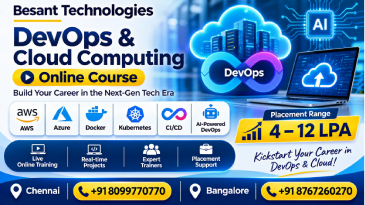
We Offer 100% Placement Assistance (Any Degree / Diploma Candidates / Year GAP / Non-IT / Any Passed Outs). Placement Records
Hire Talent (HR):+91-9707 240 250

Our DevOps and Cloud Computing Course will help you to develop practical skills by understanding the latest techniques for software development, automation of deployment and cloud computing. This course will teach you how to use some of the best tools in the industry, including Jenkins, Ansible, Docker, Kubernetes, Terraform, Git, GitHub, Maven, and SonarQube, to create CI/CD pipelines.

The course will teach you how to use AWS, Microsoft Azure, and Google Cloud Platform (GCP). It will also teach you how to use advanced technologies including Infrastructure as Code (IaC), DevSecOps, GitOps, Microservices Architecture, Container Orchestration, Configuration Management, Linux Administration, Shell Scripting, Cloud Automation, Load Balancing, Auto Scaling, and Serverless Computing. You will learn how to use monitoring tools like Prometheus, Grafana, and ELK Stack.

About Course

Besant Technologies’ DevOps and Cloud Computing Online Course provides an overview of tools that are used by DevOps Engineers. The course starts with the basics of Linux commands, Shell Scripting, Git, and GitHub. Then you will learn about automation tools like Jenkins and Maven for building CI/CD pipelines. We will have hands-on sessions on Docker, Kubernetes, Ansible, Terraform, and SonarQube.

This course will help you learn AWS, Microsoft Azure, and Google Cloud Platform (GCP). You will learn about services like EC2, S3, IAM, VPC, and Azure Virtual Machines. You will also learn about advanced tools like DevSecOps, GitOps, Helm Charts, Microservices, Prometheus, Grafana, ELK Stack, Auto Scaling, Load Balancing, and Cloud Security. By using these tools in practical sessions, you will understand how development and operations teams manage applications.

What You Will Learn

  • Learn about Linux Administration, Shell Scripting, Git, and GitHub.
  • Create and manage CI/CD pipelines using Jenkins, Maven, GitHub Actions, and SonarQube.
  • Use Docker, Kubernetes, and Helm to create containers.
  • Practice Infrastructure as Code, Configuration Management, and Automation using Terraform and Ansible.
  • Learn practical skills around AWS, Microsoft Azure, and Google Cloud, including Networking, Storage, IAM, and Serverless.
  • Explore advanced DevOps topics such as DevSecOps, GitOps, Microservices, Prometheus, Grafana, ELK Stack, Cloud Security, and Infrastructure Monitoring.

Answer 3 Simple Questions

Get upto 30%* Discount in all courses. Limited Offer. T&c Apply.

Register now

Syllabus

Session 1: Mastering Git

  • Distributed and Centralised Version Control
  • Git’s Three-Stage Architecture
  • Branching Strategies
  • Build a Git repository
  • Learn to manage AI assets (Git-LFS and Data Version Control (DVC))

Session 2: Advanced Git & GitHub

  • Initialize and push your infra & automation repos
  • GitHub auth, PR workflows, and code review etiquette
  • Resolve merge conflicts
  • Advanced Git commands

Session 3: Linux Fundamentals I

  • Linux filesystem, kernel, shell, and the FHS
  • Permissions model (rwx, octal, chmod/chown)
  • Process management (ps, top, signals, fg/bg)
  • Pipes and redirection basics

Session 4: Linux Fundamentals II – Power User

  • Text processing: grep, sed, awk one-liners
  • Finding things: find, locate, which
  • Users, groups, and sudo; packages (apt/dnf)
  • Services with systemd; disk and memory tools

Session 5: Shell Scripting

  • Shebang, variables, and quoting rules
  • Conditionals: if / case, test operators
  • Loops: for, while read, until
  • Functions, arguments, and exit codes

Session 6: Shell Scripting: Filesystems & Performance

  • Automate filesystem tasks
  • Create monitoring scripts for CPU, memory, and disk usage with alerting mechanisms
  • Learn defensive scripting techniques

Project: Make a project that combines filesystem automation and system performance reporting.

Session 7: Networking Fundamentals

  • Learn IP addressing, subnetting, and CIDR
  • Concepts of LAN/WAN
  • Networking protocols
  • Networking layers
  • Understand system communication
  • DNS fundamentals
  • Design a VPC subnet plan and visualize routing paths

Session 8: AWS Global Infrastructure & EC2 – Instance Configuration & Connectivity

  • Understand the Global AWS Structure
  • Learn the Shared Responsibility Model
  • IAM (Identity and Access Management)
  • Introduction of EC2, its core compute service, components, and configurations
  • Launch your first EC2 instance
  • Harden and configure EC2 for production
  • Understand AWS Connectivity
  • Advanced EC2 options, including EBS types, snapshots, placement groups, and metadata service
  • Prepare AI-ready compute (Golden AMIs and AWS Systems Manager)
  • Build and test a secure baseline EC2 setup

Session 9: Advanced AWS Services

  • Understand AWS Network Security Layers
  • Explore Elastic Load Balancing and Auto Scaling
  • Amazon S3 fundamentals
  • Amazon CloudWatch
  • Deploy containerized workloads on ECS
  • Store and serve datasets or ML models

Session 10: Python for Automation I

  • Python syntax, data types, functions & error handling
  • Working with files & directories (os, pathlib, shutil)
  • Rewrite your shell scripts in Python
  • Virtual environments & pip

Session 11: Python for Automation II

  • Modules & project structure; argparse CLIs
  • Calling APIs with requests; parsing JSON & YAML
  • Logging & scheduling Python jobs
  • Build a real automation CLI tool

Project: A Python CLI automation tool (log analyzer / report generator) pushed to GitHub.

Session 12: Docker + Dockerfile Project

  • Understand Virtualization vs. Containerization
  • Docker Architecture
  • Docker images and lifecycle
  • Write a production-ready Dockerfile

Project: Containerise an inference service using FastAPI or TorchServe.

Session 13: Docker: Networking, Volumes, Security & CI/CD

  • Understand Docker Networking Modes
  • Ports vs. Target ports
  • Manage volumes and Bind Mounts
  • Explore container security and compliance
  • Implement CI/CD pipelines

Project: Document image usage and operational procedures.

Session 14: SonarQube, Quality Gates, Profiles

  • Code Quality in Operations
  • Set up SonarQube
  • Enforce Quality Gates

Session 15: Jenkins CI/CD

  • Understand CI/CD fundamentals
  • Explore Jenkinsfile syntax
  • Understanding Artifact Versioning and Management
  • Configure build triggers (SCM polling, webhooks, and scheduled jobs)
  • Use Groovy scripting to enhance Jenkins pipelines and integrate GitHub webhooks
  • Apply CI/CD to an ML workflow

Session 16: Jenkins CI/CD + GitLab Integration

  • Understand Jenkins agents and Executors
  • Controller-Agent models and Dynamic Agent
  • Identify key Jenkins plugins (Docker, Git, Maven)
  • Integrate Kubernetes runners
  • GitLab CI/CD concepts
  • GitHub Actions
  • Implement an advanced multi-stage ML pipeline

Project: Set up a GitHub Actions self-hosted runner and trigger it through Jenkins for hybrid automation.

Session 17: Kubernetes Introduction

  • Understand Container Orchestration
  • Learn Kubernetes Architecture components
  • Explore nodes, pods, and services
  • Use kubectl and minikube
  • Deploy your first pod and service

Session 18: Kubernetes Basics

  • Kubernetes workloads with Deployments, ReplicaSets, Services, ConfigMaps, and Secrets
  • Understand labels, selectors, rollouts, rollbacks, and probes
  • Manage Namespaces and Resource Quotas
  • Explore multi-container pod patterns
  • Basics of KServe and Seldon
  • Perform a blue/green rollout

Session 19: Kubernetes on AWS & App Ops

  • Understand EKS (Elastic Kubernetes Service)
  • Minikube vs. EKS
  • Configure Node Groups and IRSA
  • Manage Persistent Volumes (PV/PVC)
  • Build resilience using auto-healing, Horizontal Pod Autoscaling (HPA), and rollout strategies

Project: Deploy a complete microservice application to your EKS cluster with health checks and persistent volumes.

Session 20: Advanced Kubernetes

  • RBAC and Service Accounts control permissions
  • Understand Ingress concepts
  • Package and deploy complex applications (Helm charts)
  • Fundamentals of Service Mesh (Istio)
  • Maintain cluster stability (Taints, Tolerations, and Pod Disruption Budgets)

Project: Deploy a TLS-secured EKS application using Nginx Ingress and Cert-Manager, and analyze monolith vs. microservices tradeoffs.

Session 21: Getting Started with Ansible

  • Ansible for Configuration Management
  • Difference between push and pull models
  • Ansible Architecture
  • Write and organize automation with roles, collections, variables, and facts
  • Perform your first idempotent deployment

Session 22: Automation with Ansible Playbooks

  • Organize playbooks with tags
  • Jinja2 templating
  • Secure secrets with Ansible Vault
  • Use handlers and notifiers
  • Apply Ansible for downloading, extracting, and configuring software

Project: Automate a multi-node Kubernetes cluster setup using repeatable, idempotent playbooks.

Session 23: Terraform: Introduction & State

  • Understand IaC principles
  • Terraform’s building blocks (variables, resources, data sources, outputs, and dependencies)
  • Understanding provider Authentication methods
  • Manage state backends and detect drift
  • Design and provision a VPC architecture with subnets, route tables, and gateways

Session 24: Terraform Advanced + Grafana & Prometheus

  • Learn secure and scalable Terraform project development
  • Advanced Terraform concepts
  • Terraform Workspaces
  • Understand Networking with CIDR /16
  • Create Subnet structures dynamically (Terraform)
  • Implement AWS Infrastructure Security
  • Configure drift alerts and FinOps monitoring
  • Set up and integrate Grafana, Prometheus, and MySQL

Project: Build observability dashboards for ML models – tracking latency, accuracy, and error rates.

Looking for Master your Skills? Enroll Now on Triple Course Offer & Start Learning at 24,999!

Explore Now

Upcoming Batch Schedule for DevOps and Cloud Training

Besant Technologies provides flexible timings to all our students. Here is the DevOps and Cloud Online Training Schedule in our branches. If this schedule doesn’t match please let us know. We will try to arrange appropriate timings based on your flexible timings.

  • 30-11-2026 Mon (Mon - Fri)Weekdays Batch 08:00 AM (IST)(Class 1Hr - 1:30Hrs) / Per Session Get Fees
  • 03-12-2026 Thu (Mon - Fri)Weekdays Batch 08:00 AM (IST)(Class 1Hr - 1:30Hrs) / Per Session Get Fees
  • 28-11-2026 Sat (Sat - Sun)Weekend Batch 11:00 AM (IST) (Class 3Hrs) / Per Session Get Fees
DevOps and Cloud Computing Course

Can’t find a batch you were looking for?

Corporate Training

If you want to give the Trending technology experience to your esteemed employees, we are here to help you!

Trainer Profile

Learn from Sathish Raj, a DevOps and Cloud Computing professional with over 15 years of IT industry experience. He has worked with enterprise technologies and currently serves as Senior Director – DevOps Engineering at Accenture. His expertise includes AWS, Azure, Kubernetes, Docker, Jenkins, Terraform, Ansible, CI/CD automation, Linux Administration, Infrastructure as Code (IaC), and Cloud Architecture.

During the training sessions, he shares practical examples from industry projects and explains how DevOps tools are used for application deployment, cloud infrastructure management, and production support. His teaching approach focuses on helping students understand technical concepts, practise with real-time tools, troubleshoot common issues, and gain the confidence to handle DevOps and Cloud Engineering responsibilities.

Build your resume to the latest trend, and get a chance to know our Tie-Up Companies

Placed Student's list
DevOps and Cloud Computing Course

Certification

Besant Technologies Certification is Accredited by all major Global Companies around the world. We provide after completion of the theoretical and practical sessions to fresher’s as well as corporate trainees.

Our certification at Besant Technologies is accredited worldwide. It increases the value of your resume and you can attain leading job posts with the help of this certification in leading MNC’s of the world. The certification is only provided after successful completion of our training and practical based projects.
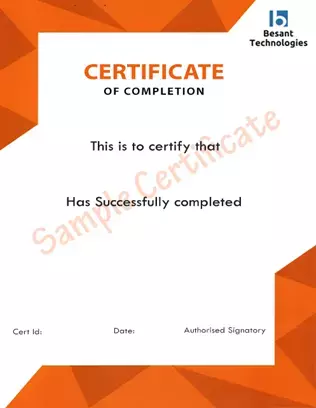
DevOps and Cloud Computing Course

Once you complete the DevOps and Cloud Computing Certification Course, Besant Technologies provides a course completion certificate to recognise your training. If you are planning to take international certification exams, trainers will also guide you with the syllabus, practice questions, and exam preparation.

You can prepare for certifications such as AWS Certified DevOps Engineer – Professional, AWS Certified Solutions Architect – Associate, Microsoft Certified: DevOps Engineer Expert (AZ-400), Google Cloud Professional Cloud DevOps Engineer, Certified Kubernetes Administrator (CKA), HashiCorp Certified: Terraform Associate, and Red Hat Certified System Administrator (RHCSA). This certification guidance helps you understand what each exam covers and where to focus your preparation. The course completion certificate and additional certification preparation can also help you present your technical skills when applying for DevOps and Cloud Engineering jobs.

Group Discount

If you have Three or more people in your training we will be delighted to offer you a group discount.

Key Features

  • Expert Trainers: Learn from expert trainers who are experienced in DevOps and Cloud Computing.
  • Complete Hands-On Training: Gain practical knowledge using Linux, Git, GitHub, Jenkins, Maven, Docker, Kubernetes, Ansible, Terraform & CI/CD pipeline tools.
  • AWS, Microsoft Azure & GCP Training: Learn to work with AWS, Microsoft Azure & Google Cloud Platform by understanding the cloud infrastructure, networking, storage & security.
  • Online and Classroom Training: Choose DevOps and Cloud Computing Online Training and classroom training based on your location, time, and convenience.
  • Live Practical Projects: Work on live projects with application deployment, container management, cloud infrastructure, and automation.
  • 100% Placement Assistance: We provide 100% placement assistance with resume building, referrals & guidance on how to apply for the right DevOps and Cloud Engineer job.
  • Mock Interviews & Technical Discussions: Get expert guidance on mock interviews and technical discussions to enhance your knowledge of DevOps tools, cloud platforms, and interview questions.
  • Job Assistance: Continue to get expert guidance from our experienced professionals to overcome technical issues, understand real-time DevOps tasks & overcome project issues.
  • Certification Guidance: Receive guidance on certification exams such as AWS, Azure, Google Cloud, Kubernetes, Terraform & others.
  • Improve Your Career Prospects & Get A Salary Increase: Improve your technical skills to get better job prospects. We will guide you to get a 100% salary increase based on your experience, skills & interview performance.

Get sample resume & tie-up companies Details

Training Courses Reviews

My main reason for joining Besant Technologies was to improve my DevOps skills and move towards better opportunities. Trainer Raj covered AWS services, Terraform, Jenkins, Docker, Kubernetes, Prometheus, and Grafana with real-time examples. The practical training helped me understand infrastructure automation and application monitoring much better. I also received useful interview support and guidance on explaining project scenarios during technical discussions. I was able to secure an opportunity at Google, which was a big step in my career.

D

Dineshwar

I had some experience in software development but wanted to learn cloud infrastructure and automation. The DevOps and Cloud Computing Training at Besant Technologies covered the topics I was looking for. My trainer, Mohammed Sir, explained Terraform, Ansible, Kubernetes, and AWS deployment in a simple way. I particularly liked the hands-on training because we worked on CI/CD pipelines instead of just learning the theory. The interview preparation sessions helped me improve my technical confidence. I am now working towards better DevOps opportunities.

S

Shankar

I was already working in IT support but wanted to move into a DevOps role. I joined Besant Technologies after a colleague recommended it. Trainer Sathish Raj explained Jenkins, Docker, Kubernetes, AWS, and CI/CD pipelines with practical examples. The hands-on sessions and live projects helped me understand how these tools are used in actual projects. The interview support was also useful, and I got an opportunity to move into a DevOps Engineer role.

H

Harini

Student's Testimonials
Frequently Asked Questions


What is covered in the DevOps and Cloud Computing Course at Besant Technologies?

The course covers Linux, Shell Scripting, Git, GitHub, Jenkins, Maven, Docker, Kubernetes, Ansible, Terraform, AWS, Azure, and Google Cloud Platform. You will also learn CI/CD pipeline automation, Infrastructure as Code, DevSecOps, GitOps, cloud networking, and monitoring tools like Prometheus and Grafana.

Is DevOps and Cloud Computing a good career option for freshers?

Yes. Freshers with an interest in software development, Linux, automation, and cloud technologies can start their careers in DevOps. Learning tools like Jenkins, Docker, Kubernetes, and AWS can help you prepare for entry-level DevOps and Cloud Engineer roles.

Can working professionals join the DevOps and Cloud Computing Training?

Yes. Working professionals from software development, testing, system administration, IT support, and networking backgrounds can join this training to upgrade their technical skills and explore DevOps career opportunities.

I am currently working in IT support. Can I switch to a DevOps Engineer role?

Yes. IT support professionals can move towards DevOps by learning Linux administration, Shell Scripting, Git, Jenkins, Docker, Kubernetes, and cloud platforms. Practical training and project experience will help you understand the responsibilities of a DevOps Engineer.

Do I need coding knowledge to learn DevOps and Cloud Computing?

Basic programming knowledge is helpful, but you don’t need to be an expert programmer to start. The course covers Shell Scripting, Python fundamentals, automation scripts, and other technical concepts required for DevOps tasks.

Which cloud platforms are covered in the DevOps training?

The training covers Amazon Web Services (AWS), Microsoft Azure, and Google Cloud Platform (GCP). You will learn about virtual machines, cloud storage, IAM, networking, security, deployment, and infrastructure management.

Will I get hands-on training with DevOps tools?

Yes. You will practise with Jenkins, Docker, Kubernetes, Terraform, Ansible, Git, and other tools through practical exercises and real-time project scenarios. This helps you understand how these technologies are used in software development and deployment.

Can software developers move into DevOps after completing this course?

Yes. Software developers can expand their skills by learning CI/CD automation, containerisation, Kubernetes, cloud infrastructure, and Infrastructure as Code. These skills can help them explore DevOps Engineer, Cloud Engineer, and Platform Engineer positions.

Is this course suitable for professionals with 3–5 years of experience?

Yes. Professionals with 3–5 years of experience in testing, development, networking, or system administration can join the course to learn advanced DevOps practices, cloud deployment, automation, and infrastructure management.

How does DevOps training help manual testers and automation testers?

Testers can learn how to integrate automated test cases into CI/CD pipelines using Jenkins and GitHub Actions. Docker, Kubernetes, and cloud platforms also help them understand application deployment and testing across different environments.

Can I learn DevOps without prior AWS or Azure experience?

Yes. You can start with the basics of cloud computing before moving on to AWS, Azure, and GCP services. The training introduces cloud concepts such as virtual machines, storage, networking, IAM, and security.

What real-time projects are included in the DevOps and Cloud Computing Course?

You will get opportunities to practise projects involving Jenkins CI/CD pipeline creation, Docker containerisation, Kubernetes application deployment, Terraform infrastructure provisioning, Ansible configuration management, and cloud-based application hosting.

Does Besant Technologies provide placement assistance for DevOps training?

Yes. Besant Technologies offers 100% placement assistance, including resume preparation, job guidance, interview preparation, and support in applying for relevant DevOps and Cloud Engineer positions.

Will I get interview support after completing the DevOps course?

Yes. Students receive interview preparation support covering technical concepts, scenario-based questions, Linux commands, AWS services, Jenkins pipelines, Docker, Kubernetes, and Terraform. Mock interview practice also helps improve confidence.

Can I attend DevOps and Cloud Computing classes online while working full-time?

Yes. Besant Technologies offers online and classroom training options. Working professionals can choose a suitable batch and attend sessions without having to leave their current jobs.

Quick Enquiry

Related Courses

Related Interview Question

Request a Callback

Land a ₹5–15 LPA IT Job in Just 120 Days With Placements, Nasscom Certification & Expert Mentors

Enroll Now