

We Offer 100% Placement Assistance (Any Degree / Diploma Candidates / Year GAP / Non-IT / Any Passed Outs). Placement Records
Hire Talent (HR):+91-9707 240 250

Trying to figure out where to actually start with Data Science? This Data Science course in Porur at Besant Technologies is built for people who want real skills, not just notes from a slide deck. It's close enough to Iyyappanthangal, Kattupakkam, and the Poonamallee High Road stretch that commuting stops being the excuse. Classes cover Python, SQL, Machine Learning, Power BI, Tableau, Data Analytics, and Generative AI, taught by people who've actually worked with these tools professionally.

Fresher, working professional, or switching in from a different field entirely — what matters is what you walk out with. Companies around Porur and the DLF IT Park stretch keep hiring for people who can actually work with data, not just explain it. This Data Science training in Porur includes live projects, a certificate you earn, and placement support built in from day one. Join classroom batches here in Porur, or take the same course online.

Have Queries? Ask our Experts

+91-8099 770 770

Available 24x7 for your queries

About the Data Science Course in Porur

Most people don’t think about this until they’re already job hunting, but a Data Science certificate on its own doesn’t mean much. Can you actually sit down with real data and do something useful with it? That’s the real test. And that gap — between what a certificate says and what you can actually pull off — is what this course is built around. One rule, basically: if you can’t apply it to a real project, it’s not learned yet, no matter how many times you’ve heard the lecture.

Porur helps here too, though not for the reasons most places put in their brochures. It’s right along the Chennai Bypass, close to Mugalivakkam and Ramapuram, so commuting stops being your excuse. A lot more companies have moved into this part of the city over the last few years, which means students training here actually get shots at internships and placement drives instead of trekking across Chennai for them.

So what does a class actually look like? Live case studies, building models on data that resembles what a real company would hand you in week one, feedback that isn’t just a pass or fail stamp. You’ll go through Python, SQL, Statistics, Machine Learning, Power BI, Tableau, and Data Visualization first, and then into what’s actually coming up in interviews this year — Generative AI, LLMs, RAG pipelines, AI agent orchestration, MCP, MLOps, AutoML, vector databases, and cloud deployment on AWS and Azure. It’s not the same LangChain-and-prompt-engineering checklist that was enough a couple years back — the field’s moved into multi-agent systems and production-grade pipelines, and that’s what’s covered here. Besant Technologies has built a name on this kind of training across our other Chennai centers, and now it’s just closer if you happen to be near Porur.

Doesn’t matter if you just graduated, you’re employed and trying to pivot into a Data Analyst or Data Scientist role, or you’re coming from something that has nothing to do with tech at all. The course meets you wherever you’re starting from. What you end up with is real project work, not a line on a resume that nobody checks. That’s usually the difference between getting shortlisted and getting skipped for roles in Data Science, Analytics, Machine Learning, and Business Intelligence. Want to see it before you commit to anything? Book a free demo (📞 +91 8099770770) — sit in on a class, talk to the trainer, go through some actual student projects.

What You’ll Learn

  • Python, SQL & Statistics — NumPy, Pandas, and the stats groundwork that keeps coming up once you’re actually doing analysis work
  • Dashboards & Reporting — Power BI and Tableau, taught well enough that a manager gets your numbers in seconds, not after a whole explanation
  • Machine Learning & Deep Learning — real algorithms, real business problems, skipping the simplified versions a lot of beginner courses stick with
  • Generative AI & Agentic Systems — hands-on with LLMs, LangChain, LangGraph, RAG pipelines, AI agent orchestration, and MCP — the frameworks running most AI-integrated Data Analytics work this year
  • MLOps & AutoML — model monitoring, CI/CD pipelines, and AutoML tools for faster, production-ready model building
  • Vector Databases & Semantic Search — embedding-based search, already the backbone of most AI-powered applications
  • Cloud Deployment — how models actually get deployed and monitored on AWS and Azure, not just how they’re built in a notebook
  • Project-Based Learning — full projects on real datasets, the kind you walk a recruiter through instead of summing up in one line
  • Career Support — resume, GitHub, interview prep, worked on one-on-one, so you’re ready when the right role near Porur or anywhere in Chennai shows up

Answer 3 Simple Questions

Get upto 30%* Discount in all courses. Limited Offer. T&c Apply.

Register now

Upcoming Batch Schedule for Data Science Training in Porur

All students at Besant Technologies have flexible schedules. The data science class schedule for the data science classroom training course can be seen below. Please let us know if the schedules do not match.

  • 12-10-2026 Mon (Mon - Fri)Weekdays Batch 08:00 AM (IST)(Class 1Hr - 1:30Hrs) / Per Session Get Fees
  • 08-10-2026 Thu (Mon - Fri)Weekdays Batch 08:00 AM (IST)(Class 1Hr - 1:30Hrs) / Per Session Get Fees
  • 10-10-2026 Sat (Sat - Sun)Weekend Batch 11:00 AM (IST) (Class 3Hrs) / Per Session Get Fees
Data Science Course in Porur

Can’t find a batch you were looking for?

Try it out, on us

Take the first step in your learning journey. Get hands-on experience and be a master. Buy 3 course @24,999/-

Learn more

Syllabus of Data Science Course in Porur

Data Science with Python

Module 1: Introduction to Data Science

  • What is Data Science?
  • What is Machine Learning?
  • What is Deep Learning?
  • What is AI?
  • Data Analytics & its types

Module 2: Introduction to Python

  • What is Python?
  • Why Python?
  • Installing Python
  • Python IDEs
  • Jupyter Notebook Overview
Hands-on-Exercise:
  • Installing Python idle for windows,Linux and
  • Creating “Hello World” code

Module 3: Python Basics

  • Python Basic Data types
  • Lists
  • Slicing
  • IF statements
  • Loops
  • Dictionaries
  • Tuples
  • Functions
  • Array
  • Selection by position & Labels
Hands-on-Exercise-Constructing Operators
  • Practice and Quickly learn Python necessary skills by solving simple questions and problems.
  • how Python uses indentation to structure a program, and how to avoid some common indentation errors.
  • You executed to make simple numerical lists, as well as a few operations you can perform on numerical lists, tuple, dictionary and set

Module 4: Python Packages

  • Pandas
  • Numpy
  • Sci-kit Learn
  • Mat-plot library
Hands-on-Exercise:
  • Installing jupyter notebook for windows, Linux and
  • Installing numpy, pandas and matplotlib

Module 5: Importing Data

  • Reading CSV files
  • Saving in Python data
  • Loading Python data objects
  • Writing data to CSV file
Hands-on-Exercise:
  • To generate data sets and create visualizations of that data. You learned to create simple plots with matplotlib, and you saw how to use a scatter plot to explore random
  • You learned to create a histogram with Pygal and how to use a histogram to explore the results of rolling dice of different
  • Generating your own data sets with code is an interesting and powerful way to model and explore a wide variety of real-world
  • As you continue to work through the data visualization projects that follow, keep an eye out for situations you might be able to model with

Module 6: Manipulating Data

  • Selecting rows/observations
  • Rounding Number
  • Selecting columns/fields
  • Merging data
  • Data aggregation
  • Data munging techniques
Hands-on-Exercise:
  • As you gain experience with CSV and JSON files, you’ll be able to process almost any data you want to analyze.
  • Most online data sets can be downloaded in either or both of these From working with these formats, you’ll be able to learn other data formats as well.

Module 7: Statistics Basics

  • Central Tendency
    • Mean
    • Median
    • Mode
    • Skewness
    • Normal Distribution
  • Probability Basics
    • What does it mean by probability?
    • Types of Probability
    • ODDS Ratio?
  • Standard Deviation
    • Data deviation & distribution
    • Variance
  • Bias variance Tradeoff
    • Underfitting
    • Overfitting
  • Distance metrics
    • Euclidean Distance
    • Manhattan Distance
  • Outlier analysis
    • What is an Outlier?
    • Inter Quartile Range
    • Box & whisker plot
    • Upper Whisker
    • Lower Whisker
    • Scatter plot
    • Cook’s Distance
  • Missing Value treatment
    • What is NA?
    • Central Imputation
    • KNN imputation
    • Dummification
  • Correlation
    • Pearson correlation
    • positive & Negative correlation
Hands-on-Exercise:
  • Compute probability in a situation where there are equally-likely outcomes
  • Apply concepts to cards and dice
  • Compute the probability of two independent events both occurring
  • Compute the probability of either of two independent events occurring
  • Do problems that involve conditional probabilities
  • Calculate the probability of two independent events occurring
  • List all permutations and combinations
  • Apply formulas for permutations and combinations

Module 8: Error Metrics

  • Classification
    • Confusion Matrix
    • Precision
    • Recall
    • Specificity
    • F1 Score
  • Regression
    • MSE
    • RMSE
    • MAPE
Hands-on-Exercise:
  • State why the z’ transformation is necessary
  • Compute the standard error of z
  • Compute a confidence interval on ρ The computation of a confidence interval
  • Estimate the population proportion from sample proportions
  • Apply the correction for continuity

Machine Learning

Supervised Learning

  • Linear Regression
    • Linear Equation
    • Slope
    • Intercept
    • R square value
  • Logistic regression
    • ODDS ratio
    • Probability of success
    • Probability of failure Bias Variance Tradeoff
    • ROC curve
    • Bias Variance Tradeoff
Hands-on-Exercise:
  • we’ve reviewed the main ways to approach the problem of modeling data using simple and definite

Unsupervised Learning

  • K-Means
  • K-Means ++
  • Hierarchical Clustering

SVM

  • Support Vectors
  • Hyperplanes
  • 2-D Case
  • Linear Hyperplane

SVM Kernal

  • Linear
  • Radial
  • polynomial

Other Machine Learning algorithms

  • K – Nearest Neighbour
  • Naïve Bayes Classifier
  • Decision Tree – CART
  • Decision Tree – C50
  • Random Forest
Hands-on-Exercise:
  • We have covered the simplest but still very practical machine learning models in an eminently practical way to get us started on the complexity
  • where we will cover several regression techniques, it will be time to go and solve a new type of problem that we have not worked on, even if it’s possible to solve the problem with clustering methods (regression), using new mathematical tools for approximating unknown values.
  • In it, we will model past data using mathematical functions, and try to model new output based on those modeling

Artificial Intelligence

Module 1: AI Introduction

  • Perceptron
  • Multi-Layer perceptron
  • Markov Decision Process
  • Logical Agent & First Order Logic
  • AL Applications

Deep Learning

Module 1: Deep Learning Algorithms

  • CNN – Convolutional Neural Network
  • RNN – Recurrent Neural Network
  • ANN – Artificial Neural Network
Hands-on-Exercise:
  • We took a very important step towards solving complex problems together by means of implementing our first neural
  • Now, the following architectures will have familiar elements, and we will be able to extrapolate the knowledge acquired on this chapter, to novel

Introduction to NLP

  • Text Pre-processing
  • Noise Removal
  • Lexicon Normalization
  • Lemmatization
  • Stemming
  • Object Standardization

Text to Features (Feature Engineering)

  • Syntactical Parsing
  • Dependency Grammar
  • Part of Speech Tagging
  • Entity Parsing
  • Named Entity Recognition
  • Topic Modelling
  • N-Grams
  • TF – IDF
  • Frequency / Density Features
  • Word Embedding’s

Tasks of NLP

  • Text Classification
  • Text Matching
  • Levenshtein Distance
  • Phonetic Matching
  • Flexible String Matching
Hands-on-Exercise:
  • provided, you will even be able to create new customized
  • As our models won’t be enough to solve very complex problems, in the following chapter, our scope will expand even more, adding the important dimension of time to the set of elements included in our generalization.

Tableau

Module 1: Tableau Course Material

  • Start Page
  • Show Me
  • Connecting to Excel Files
  • Connecting to Text Files
  • Connect to Microsoft SQL Server
  • Connecting to Microsoft Analysis Services
  • Creating and Removing Hierarchies
  • Bins
  • Joining Tables
  • Data Blending

Module 2: Learn Tableau Basic Reports

  • arameters
  • Grouping Example 1
  • Grouping Example 2
  • Edit Groups
  • Set
  • Combined Sets
  • Creating a First Report
  • Data Labels
  • Create Folders
  • Sorting Data
  • Add Totals, Subtotals and Grand Totals to Report

Hands-on-Exercise:

  • Install Tableau Desktop
  • Connect Tableau to various Datasets: Excel and CSV files

Module 3: Learn Tableau Charts

  • Area Chart
  • Bar Chart
  • Box Plot
  • Bubble Chart
  • Bump Chart
  • Bullet Graph
  • Circle Views
  • Dual Combination Chart
  • Dual Lines Chart
  • Funnel Chart
  • Traditional Funnel Charts
  • Gantt Chart
  • Grouped Bar or Side by Side Bars Chart
  • Heatmap
  • Highlight Table
  • Histogram
  • Cumulative Histogram
  • Line Chart
  • Lollipop Chart
  • Pareto Chart
  • Pie Chart
  • Scatter Plot
  • Stacked Bar Chart
  • Text Label
  • Tree Map
  • Word Cloud
  • Waterfall Chart
Hands-on-Exercise:
  • Create and use Static Sets
  • Create and use Dynamic Sets
  • Combine Sets into more Sets
  • Use Sets as filters
  • Create Sets via Formulas
  • Control Sets with Parameters
  • Control Reference Lines with Parameters

Module 4: Learn Tableau Advanced Reports

  • Dual Axis Reports
  • Blended Axis
  • Individual Axis
  • Add Reference Lines
  • Reference Bands
  • Reference Distributions
  • Basic Maps
  • Symbol Map
  • Use Google Maps
  • Mapbox Maps as a Background Map
  • WMS Server Map as a Background Map
Hands-on-Exercise:
  • Create Barcharts
  • Create Area Charts
  • Create Maps
  • Create Interactive Dashboards
  • Create Storylines
  • Understand Types of Joins and how they work
  • Work with Data Blending in Tableau
  • Create Table Calculations
  • Work with Parameters
  • Create Dual Axis Charts
  • Create Calculated Fields

Module 5: Learn Tableau Calculations & Filters

  • Calculated Fields
  • Basic Approach to Calculate Rank
  • Advanced Approach to Calculate Ra
  • Calculating Running Total
  • Filters Introduction
  • Quick Filters
  • Filters on Dimensions
  • Conditional Filters
  • Top and Bottom Filters
  • Filters on Measures
  • Context Filters
  • Slicing Fliters
  • Data Source Filters
  • Extract Filters
Hands-on-Exercise:
  • Creating Data Extracts in Tableau
  • Understand Aggregation, Granularity, and Level of Detail
  • Adding Filters and Quick Filters

Module 6: Learn Tableau Dashboards (Duration – 4 Hours)

  • Create a Dashboard
  • Format Dashboard Layout
  • Create a Device Preview of a Dashboard
  • Create Filters on Dashboard
  • Dashboard Objects
  • Create a Story

Module 7: Server (Duration – 5 Hours)

  • Tableau online.
  • Overview of Tableau
  • Publishing Tableau objects and scheduling/subscription.
Hands-on-Exercise:
  • Create Data Hierarchies
  • Adding Actions to Dashboards (filters & highlighting)
  • Assigning Geographical Roles to Data Elements
  • Advanced Data Preparation

Oracle Database

Introduction to Oracle Database

  • List the features of Oracle Database 11g
  • Discuss the basic design, theoretical, and physical aspects of a relational database
  • Categorize the different types of SQL statements
  • Describe the data set used by the course
  • Log on to the database using SQL Developer environment
  • Save queries to files and use script files in SQL Developer
Hands-on-Exercise:
  • Prepare your environment
  • Work with Oracle database tools
  • Understand and work with language features

Retrieve Data using the SQL SELECT Statement

  • List the capabilities of SQL SELECT statements
  • Generate a report of data from the output of a basic SELECT statement
  • Select All Columns
  • Select Specific Columns
  • Use Column Heading Defaults
  • Use Arithmetic Operators
  • Understand Operator Precedence
  • Learn the DESCRIBE command to display the table structure
Hands-on-Exercise
  • Individual statements in SQL scripts are commonly terminated by a line break (or carriage return) and a forward slash on the next line, instead of a semicolon.
  • You can create a SELECT statement, terminate it with a line break, include a forward slash to execute the statement, and save it in a script file.

Learn to Restrict and Sort Data

  • Write queries that contain a WHERE clause to limit the output retrieved
  • List the comparison operators and logical operators that are used in a WHERE clause
  • Describe the rules of precedence for comparison and logical operators
  • Use character string literals in the WHERE clause
  • Write queries that contain an ORDER BY clause to sort the output of a SELECT statement
  • Sort output in descending and ascending order
Hands-on-Exercise:
  • Creating the queries in a compound query must return the same number of columns.
  • Create corresponding columns in each query must be of compatible data types.
  • ORDER BY; it is, however, permissible to place a single ORDER BY clause at the end of the compound query

Usage of Single-Row Functions to Customize Output

  • Describe the differences between single row and multiple row functions
  • Manipulate strings with character function in the SELECT and WHERE clauses
  • Manipulate numbers with the ROUND, TRUNC, and MOD functions
  • Perform arithmetic with date data
  • Manipulate dates with the DATE functions
Hands-on-Exercise:
  • Create the distinction is made between single- row functions, which execute once for each
  • row in a dataset, and multiple-row functions, which execute once for all the rows in a data- set.

Invoke Conversion Functions and Conditional Expressions

  • Describe implicit and explicit data type conversion
  • Use the TO_CHAR, TO_NUMBER, and TO_DATE conversion functions
  • Nest multiple functions
  • Apply the NVL, NULLIF, and COALESCE functions to data
  • Use conditional IF THEN ELSE logic in a SELECT
Hands-on-Exercise:
  • we create and discuss the NVL function, which provides a mechanism to convert null values into more arithmetic-friendly data values.

Aggregate Data Using the Group Functions

  • Use the aggregation functions in SELECT statements to produce meaningful reports
  • Divide the data into groups by using the GROUP BY clause
  • Exclude groups of date by using the HAVING clause
Hands-on-Exercise:
  • Group functions operate on aggregated data and return a single result per group.
  • These groups usually consist of zero or more rows of data.

Display Data from Multiple Tables Using Joins

  • Write SELECT statements to access data from more than one table
  • View data that generally does not meet a join condition by using outer joins
  • Join a table by using a self-join

Use Subqueries to Solve Queries

  • Describe the types of problem that subqueries can solve
  • Define sub-queries
  • List the types of sub-queries
Hands-on-Exercise:
  • Write a query that uses subqueries in the column projection list.
  • Write single-row and multiple-row subqueries

The SET Operators

  • Describe the SET operators
  • Use a SET operator to combine multiple queries into a single query
  • Control the order of rows returned
Hands-on-exercise:
  • Create The queries in the compound query must return the same number of columns.
  • creating The corresponding columns must be of compatible data type.
  • creating The set operators have equal precedence and will be applied in the order they are specified.

Data Manipulation Statements

  • Describe each DML statement
  • Insert rows into a table
  • Change rows in a table by the UPDATE statement
  • Delete rows from a table with the DELETE statement
  • Save and discard changes with the COMMIT and ROLLBACK statements
  • Explain read consistency
Hands-on-exercise:
  • Expressions and create expose a vista of data manipulation possibilities through the interaction of arithmetic and character operators with column or literal data, or a combination of the two.

Use of DDL Statements to Create and Manage Tables

  • Categorize the main database objects
  • Review the table structure
  • List the data types available for columns
  • Create a simple table
  • Decipher how constraints can be created at table creation
  • Describe how schema objects work

Other Schema Objects

  • Create a simple and complex view
  • Retrieve data from views
  • Create, maintain, and use sequences
  • Create and maintain indexes
  • Create private and public synonyms

Control User Access

  • Differentiate system privileges from object privileges
  • Create Users
  • Grant System Privileges
  • Create and Grant Privileges to a Role
  • Change Your Password
  • Grant Object Privileges
  • How to pass on privileges?
  • Revoke Object Privileges
Hands-on-exercise:
  • create users and execute the

Management of Schema Objects

  • Add, Modify and Drop a Column
  • Add, Drop and Defer a Constraint
  • How to enable and Disable a Constraint?
  • Create and Remove Indexes
  • Create a Function-Based Index
  • Perform Flashback Operations
  • Create an External Table by Using ORACLE_LOADER and by Using ORACLE_DATAPUMP
  • Query External Tables
Hands-on-exercise:
  • Create the function based index and types.

Manage Objects with Data Dictionary Views

  • Explain the data dictionary
  • Use the Dictionary Views
  • USER_OBJECTS and ALL_OBJECTS Views
  • Table and Column Information
  • Query the dictionary views for constraint information
  • Query the dictionary views for view, sequence, index, and synonym information
  • Add a comment to a table
  • Query the dictionary views for comment information

Manipulate Large Data Sets

  • Use Subqueries to Manipulate Data
  • Retrieve Data Using a Subquery as Source
  • Insert Using a Subquery as a Target
  • Usage of the WITH CHECK OPTION Keyword on DML Statements
  • List the types of Multitable INSERT Statements
  • Use Multitable INSERT Statements
  • Merge rows in a table
  • Track Changes in Data over a period of time

Data Management in Different Time Zones

  • Time Zones
  • CURRENT_DATE, CURRENT_TIMESTAMP, and LOCALTIMESTAMP
  • Compare Date and Time in a Session’s Time Zone
  • DBTIMEZONE and SESSIONTIMEZONE
  • Difference between DATE and TIMESTAMP
  • INTERVAL Data Types
  • Use EXTRACT, TZ_OFFSET, and FROM_TZ
  • Invoke TO_TIMESTAMP, TO_YMINTERVAL and TO_DSINTERVAL

Retrieve Data Using Sub-queries

  • Multiple-Column Subqueries
  • Pairwise and Non Pairwise Comparison
  • Scalar Subquery Expressions
  • Solve problems with Correlated Subqueries
  • Update and Delete Rows Using Correlated Subqueries
  • The EXISTS and NOT EXISTS operators
  • Invoke the WITH clause
  • The Recursive WITH clause

Regular Expression Support

  • Use the Regular Expressions Functions and Conditions in SQL
  • Use Meta Characters with Regular Expressions
  • Perform a Basic Search using the REGEXP_LIKE function
  • Find patterns using the REGEXP_INSTR function
  • Extract Substrings using the REGEXP_SUBSTR function
  • Replace Patterns Using the REGEXP_REPLACE function
  • Usage of Sub-Expressions with Regular Expression Support
  • Implement the REGEXP_COUNT function
Hands-on-exercise:
  • Expressions and create the regular columns may be aliased using the AS keyword or by leaving a space between the column or expression and the alias. In this way, both wildcard symbols can be used as either specialized or regular characters in different segments of the same character string.

Download Data Science Course Syllabus

Corporate E-Learning & Training

Educate employee's in form of learning programs means in turn the success of your business/organization.

Tune up

Meet Arjun – Data Science Trainer in Porur

The trainer you pick shapes a lot more of the outcome than people expect going in. Arjun has worked with 6,500+ students so far — some straight out of college, some already employed and trying to switch into a data role, others coming from backgrounds that have nothing to do with tech at all. He spent years building and deploying models for companies before he ever stepped into a classroom, and his classes reflect that — less textbook walkthrough, more “here’s what actually happens when this goes live.” Students have joined his sessions from India, the US, UK, Singapore, and the Netherlands, either in person at our Porur center or live online.

Skills Built From Doing the Work, Not Just Explaining It

  • Current Tools & Concepts — Python, SQL, Machine Learning, Deep Learning, NLP, Power BI, Tableau, Generative AI, AI Agents, LangChain, LangGraph, RAG, MCP, vector databases, and MLOps, taught through real business scenarios instead of simplified textbook versions
  • Projects Come First — you’ll build working applications, dashboards, and predictive models on datasets that actually look like what companies deal with day to day, the kind of Data Analytics work you’d genuinely be handed in a real job
  • Explains the “Why,” Not Just the “How” — a lot of trainers just show which button to click without explaining why a model behaves a certain way. Students say this is the one thing that actually made things stick instead of getting forgotten the week after class
  • Support That Runs Through the Whole Course — resume help, GitHub reviews, LinkedIn guidance, mock interviews, all happening alongside the training, not crammed in after it’s already wrapped up

What Joining in 2026 Actually Looks Like

  • Less Time Stuck on Outdated Basics — nobody wants three weeks on Excel formulas anymore. Students want to get to Machine Learning and AI tools faster, and the pacing here reflects that instead of dragging fundamentals out longer than they need to be
  • A Real Portfolio Beats a Printed Certificate — hiring managers this year skim resumes but actually click into GitHub links. Every project is built with that in mind, so what you walk out with is something worth someone actually opening
  • Honest Talk About Where Roles Are Headed — instead of a vague “AI will change everything” speech, there’s real discussion on which Data Science roles are growing, which are getting automated, and where you’d actually fit

Why Students Near Porur Pick This Training

  • 6,500+ Students Trained, across both technical and completely non-technical starting points
  • Classroom Batches Right Here in Porur, with live online sessions open to anyone joining from Iyyappanthangal, Kattupakkam, or Manapakkam
  • A Trainer Who’s Taught Beyond Chennai, including learners from the US, UK, Singapore, and a few other countries along the way

Built Toward Getting You Hired

  • Interview Prep That Actually Helps — mock technical rounds, live coding practice, and questions pulled from real interviews, not the same recycled list every prep guide copies
  • A Profile Recruiters Take Seriously — a GitHub worth clicking into, a resume that clears ATS filters instead of getting stuck in a pile, and a LinkedIn profile that looks like you wrote it, not a template someone filled in
  • Placement Support That Goes Beyond “Good Luck” — guidance toward Data Analyst, Data Scientist, Machine Learning, and Business Intelligence roles across Chennai, Bengaluru, and other cities where hiring is genuinely active right now

Book a Free Demo With Arjun 📞 +91 8099770770 — Start Your Data Science Course in Porur

Find your next job with Besant

400+ Students getting placed every month from startup to top level MNC's with decent package after doing course.

Placement record Get your job

Data Science Certification Course in Porur — Besant Technologies

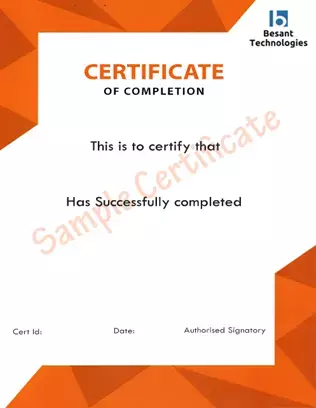
Besant Technologies Certification is Accredited by all major Global Companies around the world. We provide after completion of the theoretical and practical sessions to fresher’s as well as corporate trainees.

Our certification at Besant Technologies is accredited worldwide. It increases the value of your resume and you can attain leading job posts with the help of this certification in leading MNC’s of the world. The certification is only provided after successful completion of our training and practical based projects.
Data Science Course in Porur

A lot of certificates just prove you sat through a few weeks of classes. This one doesn’t work that way. To actually get the Besant Technologies Course Completion Certificate, you go through hands-on projects, technical assessments, AI-based case studies, and a capstone project — and at the end, you sit down and explain what you built, not just hand in a file and hope nobody asks follow-up questions.

Here’s the honest part: the training lines up with what’s tested in certifications like IBM’s Data Science Professional Certificate, Microsoft’s Azure Data Scientist Associate, and Google’s Data Analytics Professional Certificate, so if you want to go after one of those down the line, you’re not starting from scratch. But what actually matters more, day to day, is what recruiters near Porur, Mugalivakkam, and along the Chennai Bypass look for — whether you can sit down and do the work. Python, statistical modeling, Machine Learning, proven through something you built with your own hands, not a syllabus you skimmed through once.

Three Checkpoints Before You’re Certified

  • Cover the entire curriculum — Python, Statistics, Machine Learning, Deep Learning, NLP, and where the field’s actually headed: Generative AI, LLMs, Agentic AI systems, MLOps
  • Build and deploy something real — not a classroom demo, an actual working project on a real dataset, using LangChain, LangGraph, RAG pipelines, AI agent orchestration, vector databases, and prompt engineering
  • Get tested on applied skills — Python, SQL, model building, feature engineering, basic AWS or Azure deployment, Docker, and either Power BI or Tableau

One Thing Most Courses Skip: Knowing What the Certificate Is Actually Worth

  • It’s Not Just a PDF to File Away — recruiters near Porur and across Chennai have started asking candidates to walk through their capstone project in interviews, not just list it. This certificate only means something because there’s a real project behind it that can survive that conversation
  • Keeps Up With What’s Changing, Not What Already Changed — a certificate earned two years ago on an outdated syllabus doesn’t carry the same weight anymore. This one reflects what’s being asked for in interviews this year, not what was relevant back then

Why Bother Getting Certified At All

  • Your resume stops getting filtered out by ATS software before a human even sees it, your LinkedIn actually shows up when a recruiter searches, and your GitHub backs up every line on paper instead of contradicting it
  • A real shot at roles like Data Analyst, Machine Learning Engineer, Data Scientist, or Business Intelligence Analyst — Applied AI and MLOps roles too, if that’s more the direction you’re headed
  • It travels with you — whether you’re applying in Porur, elsewhere in Chennai, or overseas, this certificate backs up things you can actually talk through in an interview, not just things you wrote down once and forgot

Still unsure if this is the right fit? Call 📞 +91 8099770770 or grab a free demo slot and ask the trainer directly before deciding — Begin Your Data Science Certification Journey in Porur

Group Discount

Join in a group of three or more on same course we will be delighted to offer you a group discount.

Get Discount

Key Features of the Data Science Course in Porur

Plenty of Data Science courses exist. Very few actually test what you learn against something real before calling it “done.” That’s the line this course draws at Besant Technologies — the curriculum in Porur is built around what Chennai’s IT and business hubs are actually hiring for, not a syllabus that’s been sitting untouched for years.

Who’s Teaching, and Who Else Is in the Room

  • A Trainer Who’s Built Things, Not Just Lectured About Them — Arjun spent years building and deploying models for companies before he ever ran a classroom, so when he explains something, it comes from what actually goes wrong once it’s live, not a clean textbook version
  • A Batch With More Than One Perspective — past students have joined from India, the US, UK, Singapore, and the Netherlands, so discussions in class pull from more than one country’s way of thinking about hiring and problem-solving
  • Learn However Works Best for You — attend classroom sessions at our Porur center, or join live online from Iyyappanthangal, Kattupakkam, or anywhere along the Poonamallee stretch, with weekday and weekend batches running either way

What’s Actually Covered, Built for Where the Field Is Headed

  • Core Stack — Python, SQL, Machine Learning, Deep Learning, NLP, Power BI, Tableau, Docker, Git & GitHub, plus cloud deployment on AWS and Azure
  • Where Generative AI Fits In — LLMs, LangChain, LangGraph, RAG pipelines, AI agent orchestration, and MCP, the frameworks most AI-driven Data Science and Data Analytics roles are actually built on this year, not the single-agent setups that were standard a couple of years back
  • MLOps, Kept Practical — model monitoring, CI/CD pipelines, and AutoML tools, taught as things you’ll reach for on the job, not terms you memorize once and forget by the next module
  • Vector Databases and Semantic Search — already the backbone of most AI-powered products, and something a lot of entry-level courses still skip over completely
  • What Companies Are Starting to Ask For Next — early exposure to multi-agent systems and retrieval-augmented workflows, since hiring conversations have already started moving past single-model setups toward teams of AI agents working together
  • Taking a Model Past the Notebook Stage — you’ll deploy something that actually runs, not leave a trained model sitting untouched in a Jupyter file forever
  • Work That Doesn’t Disappear After Grading — every project is built to stay useful later, on your GitHub, in an interview, wherever you need to prove what you can actually do

Once Classes Wrap Up

  • A Syllabus Built Around Real Hiring Needs — Data Science and Data Analytics training in Porur covering Python, SQL, Machine Learning, Power BI, Tableau, MLOps, and the data engineering work companies across Chennai are asking for right now
  • Interview Prep That Isn’t Squeezed In at the End — mock technical rounds, coding practice, an ATS-friendly resume, and LinkedIn support, built into the course from the start, not added on later
  • Placement Support Across Chennai’s Hiring Market — guidance toward Data Analyst, Data Scientist, Machine Learning, and Business Intelligence roles in Porur and the wider Chennai job market, planned early instead of rushed together at the end
  • A Certificate You Actually Earn — a Besant Technologies Data Science Course Completion Certificate, issued only once your assignments, assessments, and projects are genuinely finished, not for just sitting through the sessions

Ready to jump-start your career

Join the course, Get your resume modified from experts. Our students are being hired at the leading companies.

Let's go

Training Courses Reviews

I would like to highlight a few points about my association with Besant Technologies. The faculty members out here are super supportive. They make you understand a concept till they are convinced you have gotten a good grip over it. The second upside is definitely the amount of friendliness in their approach. I and my fellow mates always felt welcome whenever we had doubts. Thirdly, Besant offers extra support to students with a weaker understanding of the field of IT.

s

Siva Kumar

When I joined Besant Technologies, I didn’t really expect a lot from it, to be extremely honest. But as time went by, I realised I got from Besant Technologies exactly what I wanted- a healthy environment for learning. Cordial teachers and their valuable lectures make understanding things so much easy. I thank Besant for having been so supportive throughout the course.

D

Daniel

Student's Testimonials

Student's Testimonials

Student's Testimonials

Frequently Asked Questions


What is the Data Science Course in Porur?

It’s built around how data actually gets collected, cleaned, analyzed, and turned into decisions a business can act on. Training covers Python, SQL, statistics, data visualization, and Machine Learning, with enough hands-on practice and projects that it’s not just theory you forget later.

Who can actually join this course?

Graduates, freshers, working professionals, people from non-IT backgrounds — all of it. You don’t need a Computer Science degree to start. If you’re ready to practice regularly, you can build this up from the basics.

I don't know how to code. Can I still learn Data Science?

Yes. You can start even if you’ve never written a line of code. Python is taught from scratch — variables, conditions, functions — before you move into Pandas, NumPy, and Matplotlib.

What topics does the course actually cover?

Python, SQL, statistics, data cleaning, exploratory data analysis, visualization, and Machine Learning, mostly. You’ll also get hands-on exposure to Jupyter Notebook, Power BI, Git, Pandas, NumPy, Matplotlib, Seaborn, and Scikit-learn, depending on the batch.

How long does Data Science training in Porur actually take?

Depends on the batch schedule and how deep the training goes. Finishing classes fast isn’t really the point — you need time to practice Python and SQL, work through datasets, build projects, and prep for interviews. Going steady usually works out better than rushing.

What's the fee for the Data Science course in Porur?

It varies based on duration, syllabus, trainer, how much practical training’s involved, project work, and career support. Worth checking exactly what you’re getting before picking an institute on price alone.

Will I actually get real project experience during the course?

Yes, project work is a big part of this. You’ll work with real datasets — cleaning, analyzing, visualizing, predicting — the kind of work you can actually talk through properly in an interview later.

Are Python and SQL actually part of this course?

Yes, both are core to the training. Python handles most of the analysis and Machine Learning side, SQL is what you use to pull data from databases. Knowing both solidly makes you far more employable for data roles.

Is Data Science a good path for freshers?

Can be, if you actually enjoy working with data and solving problems. Since freshers don’t have work experience to fall back on, building solid projects and getting comfortable with Python, SQL, statistics, and Machine Learning goes a long way for entry-level roles.

I'm already working. Can I still switch into Data Science?

Yes. A lot of working professionals do exactly this — learning gradually while still holding down their job. What matters most is staying consistent with practice and building projects that match the role you’re actually aiming for.

Does this course include placement support?

Yes — resume help, mock interviews, interview guidance, and support finding relevant openings. That said, placement support sharpens your chances, but getting hired still comes down to your skills, your projects, and how you come across in the interview.

How do I know if a Data Science institute in Porur is actually worth it?

Check the syllabus, how experienced the trainer actually is, how much hands-on practice you get, the projects involved, and the career support included. Make sure Python, SQL, statistics, analysis, visualization, and Machine Learning are all genuinely covered, not just theory dressed up as practical training.

Stay in the loop

Enroll for Classroom, Online, Corporate training.

Take the next step

Tell us what you’re looking for. Our expert team will help you find the best solution.

Contact sales

Besant Technologies Data Science Course in Porur View 9 Locations Nearby

Velachery

No.8, 11th Main road, Vijaya nagar,
Velachery, Chennai – 600 042
Tamil Nadu, India.

Landmark: Reliance Digital Showroom Opposite Street
View Location

Tambaram

1st Floor, No.2A Duraisami Reddy Street,
West Tambaram, Chennai – 600 045
Tamil Nadu,India.

Landmark:Near By Passport Seva
View Location

OMR

No. 5/318, 2nd Floor, Sri Sowdeswari Nagar,
OMR, Okkiyam Thoraipakkam, Chennai – 600 097
Tamil Nadu, India.

Landmark:Behind Okkiyampet Bus Stop
View Location

Porur

First Floor, 105C,
Mount Poonamallee Rd,
Sakthi Nagar, Porur,
Chennai, Tamil Nadu 600 116

Landmark: Near Saravana Stores
View Location

Anna Nagar

No.AK-2, RBN Tower, 1st Floor,
4th Avenue, Shanthi Colony,
Anna Nagar, Chennai - 600 040
Tamil Nadu, India

View Location

T.Nagar

48/4 ,2nd Floor, N Usman Rd,
Parthasarathi Puram, T. Nagar,
Chennai, Tamil Nadu 600017

Landmark:Opposite to Pantloons Showroom
View Location

Thiruvanmiyur

Plot no:140, 74/1 1st Floor, Janaki
Commercial Complex, Lattice Brg Rd
Thiruvanmiyur, Chennai - 600041

Landmark:Jayathi Theatre, Bus Stop
View Location

Maraimalai Nagar

No.37, 1st Floor, Thiruvalluvar Salai,
Maraimalai Nagar, Chennai 603 209,
Tamil Nadu, India

Landmark: Near to Maraimalai Nagar Arch
View Location

Siruseri

No. 4/76, Ambedkar Street, OMR Road,
Egatoor, Navallur, Siruseri, Chennai 600 130
Tamil Nadu, India

Landmark:Near Navallur Toll Gate
View Location
Besant Support

We're here to help

Know more about our products, find a sales partner and get specific answers from our expert team any time.

Get Support
Request a Callback

Land a ₹5–15 LPA IT Job in Just 120 Days With Placements, Nasscom Certification & Expert Mentors

Enroll Now